Few things are as frustrating in the kitchen as a meat grinder that struggles, smearing rather than cleanly cutting your meat. This common issue often stems from dull blades, which not only compromise the texture of your ground product but also put undue strain on your appliance’s motor, potentially shortening its lifespan. But don’t despair! Restoring the razor-sharp edge to your meat grinder blades is a surprisingly straightforward DIY task that anyone can tackle with a few basic tools and a little patience. This guide will walk you through everything you need to know, transforming your dull grinder into an efficient, meat-processing powerhouse once again.
Understanding Your Meat Grinder Blades
At the heart of every meat grinder’s efficiency lies the symbiotic relationship between its blade and the grinder plate. These two components work in tandem, performing a “scissor-like” action that cleanly slices through meat. When your blades are sharp, this action is smooth and precise, yielding consistently textured ground meat. However, over time and with regular use, the edges of both the blade and the plate inevitably wear down.
When your meat grinder blades become dull, they lose their ability to cut cleanly. Instead of slicing, they begin to crush and tear the meat, leading to a host of problems. You’ll notice your grinder struggling, perhaps even jamming, and the resulting ground meat will have a mushy or inconsistent texture. This dullness also forces the motor to work harder, increasing wear and tear and potentially leading to premature failure of your appliance. Regularly sharpening your meat grinder blades is therefore not just about better ground meat; it’s about extending the life of your equipment and ensuring efficient, consistent performance.
Essential Tools for DIY Blade Sharpening
Successfully sharpening your meat grinder blades at home requires a few readily available tools. Most of these can be found in a typical home workshop or purchased affordably. Gathering them before you start will ensure a smooth and efficient sharpening process.
- Perfectly Flat Surface: This is non-negotiable for achieving a truly flat and sharp edge. Options include a thick piece of plate glass, a smooth granite or marble tile, or even a very flat countertop. Avoid using wood or uneven surfaces, as they will prevent uniform sharpening.
- Wet/Dry Sandpaper in Various Grits: You’ll need a progression of sandpaper grits, starting coarse and moving to very fine. A good selection would include 220, 400, 800, and 1500 grit. The lower the number, the more abrasive the paper, used for shaping the metal; higher numbers refine and polish the edge. Some methods suggest starting as low as 120 grit and finishing at 600 grit.
- Water (in a spray bottle): Water acts as a lubricant for the sandpaper, helping to carry away metal particles (swarf) and preventing the paper from clogging.
- Permanent Marker: This simple tool is surprisingly useful. By coloring the blade’s surface, you can visually track your progress, ensuring you’re sharpening evenly across the entire surface.
- Cut-Resistant Gloves: Even dull blades can cause nasty cuts. Safety should always be your priority, making a pair of cut-resistant gloves an essential investment.
- Old Newspaper or Paper Towels: For wiping down components and testing sharpness.
- Optional: Sharpening Stone and Honing Oil: While sandpaper is highly effective, a sharpening stone can also be used, typically with honing oil to reduce friction and prevent clogging.
Step-by-Step Guide to Sharpening Meat Grinder Blades with Sandpaper
The sandpaper-on-a-flat-surface technique is widely regarded as one of the most accessible and reliable DIY methods for achieving exceptional results. This process ensures both the blade and the grinder plate are perfectly flat, allowing for that crucial “scissor-like” action.
Step 1: Disassembly and Cleaning
|
Our Picks for the Best Meat Grinder in 2026
As an Amazon Associate I earn from qualifying purchases.
|
||
| Num | Product | Action |
|---|---|---|
| 1 | Electric Meat Grinder, Sausage Stuffer with 3 Sausage Tubes, 2 Blades, 3 Plates, 3200W Max, Meat Grinder Heavy Duty for Home Kitchen Use, Stainless Steel (Black) |

|
| 2 | Cuisinart Electric Meat Grinder, Stainless Steel |
|
| 3 | AAOBOSI #12 Meat Grinder, [3000W] 3 Speed Meat Grinder Heavy Duty: Built-in Storage Box, 2 Blades,4 Plates,3 Sausage Stuffers,Kibbe Kit,Meat Claw & Burger Press, for Home & Kitchen Use |
|
| 4 | Weston Electric Meat Grinder & Sausage Stuffer, #12 750 Watt, 1 HP Motor, Grinds 4 lbs Per Minute, Includes Stainless Steel Grinding Plates, Die-Cast Aluminum (33-1301-W) |
|
| 5 | VEVOR Commercial Electric Meat Grinder, 5 lbs/min Capacity, #8 Industrial Meat Mincer with 2 Stainless Steel Blades, 2 Grinding Plates, 600W Heavy-Duty Sausage Maker Stuffer, for Kitchen, Restaurant |
|
| 6 | AAOBOSI Meat Grinder Electric 3000W Max with Touch Color Screen, Auto-Reverse & Built-in Storage - 3 Speed Settings,Grinding, Sausage & Kibbe Making for Home Use, Stainless Steel |
|
| 7 | Camic Electric Meat Grinder - 300W Sausage Stuffer for Home Kitchen Use Meat Mincer with Stainless Steel 3 Plates, 1 Blade, Sausage Tube, Kubbe Maker |
|
| 8 | AAOBOSI Multifunctional Digital Meat Grinder Electric 3000W Max w/ 9 Touch Screen Presets, Auto-Reverse & Built-in Storage -Grinding, Sausage & Kibbe & Grate Cheese Making for Home Use |
|
| 9 | Meat Grinder, Electric Meat Grinder with Sausage Stuffer Maker & Kubbe Kit, Metal-Body Meat Mincer with 3 Stainless Steel Grinding Plates & 2 Blades for Home Kitchen Using |
|
| 10 | CHEFFANO Meat Grinder, 2600W Max Stainless Steel Meat Grinder Electric, ETL Approved Heavy Duty Meat Mincer Machine with 2 Blades, 3 Plates, Sausage Stuffer Tube & Kubbe Kit for Home Kitchen Use |
|
Before you begin any sharpening, safety and cleanliness are paramount. Carefully disassemble the head of your meat grinder, removing the ring cap, the grinder plate, and the blade. Take care during this process, as even dull parts can still have sharp edges. Wash all these components thoroughly in warm, soapy water to remove any residual fat, meat particles, or grime. A small brush can be helpful for reaching crevices. Rinse them well and dry them completely. Any leftover debris can interfere with the sharpening process and lead to uneven results.
Step 2: Preparing Your Workspace
Once your components are clean and dry, it’s time to set up your sharpening station. Lay your chosen perfectly flat surface (glass, granite) on a stable countertop or workbench. Lightly spray the surface with water, then carefully place your coarsest piece of sandpaper (e.g., 220 grit) onto it. The water will help the sandpaper adhere and prevent it from sliding around during the sharpening process. Before handling the blade, put on your cut-resistant gloves to protect your hands. Now, take your permanent marker and completely color in the flat, forward-facing side of the meat grinder blade—this is the side with the four arms that presses against the plate. This marker will serve as a visual guide to ensure you’re removing material evenly.
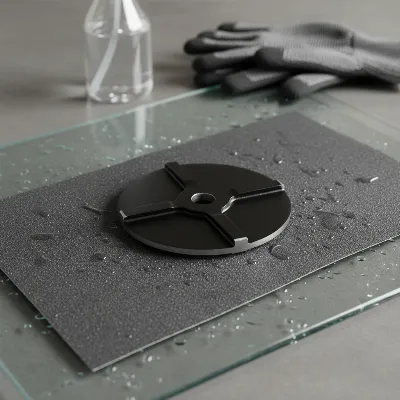 A meat grinder blade marked with a permanent marker, placed on coarse grit sandpaper on a flat glass surface, with safety gloves and a spray bottle nearby.
Step 3: The Coarse Grit Lap (Flattening the Edge)
With your workspace prepared, it’s time for the foundational lap. Place the marked meat grinder blade flat against the coarsest sandpaper. Using light, even pressure, move the blade in a figure-eight pattern across the sandpaper. The goal here is not just to sharpen the edge but to achieve perfect flatness across the entire blade surface that makes contact with the grinder plate. Continue this motion until all the permanent marker has been removed and you see a consistent, uniform scratch pattern across the entire flat side of the blade. This typically takes a few minutes, depending on how dull the blade was. Take your time, ensuring even pressure to avoid creating an uneven edge.
Step 4: Refining the Edge with Finer Grits
After the coarse grit has done its job, you’ll move to progressively finer grits of sandpaper to refine and polish the edge. Replace the 220-grit paper with the next finer grit (e.g., 400 grit). You don’t need to re-apply the marker for these subsequent steps, as the initial coarse grit pass has already established the flat plane. Lightly spray the new sandpaper with water. Place the blade on the paper and repeat the same figure-eight lapping motion you used before. Since these grits are less aggressive, you won’t need to work as long—thirty to forty seconds per grit should be sufficient to replace the previous, coarser scratch pattern with a finer one. Continue this process, moving from 400 to 800, and finally to 1500 grit. Each finer grit will progressively polish the surface, resulting in a smoother, sharper edge. The aim is to remove the scratches from the previous grit, leaving a highly refined surface.
Step 5: Final Touches, Testing, and Reassembly
Once you’ve worked through all the grits, carefully wipe away any metal shavings or residue from the blade and grinder plate. To test the sharpness, you can try slicing a piece of paper with the edge—a truly sharp blade should cut cleanly without tearing. Rinse both the blade and the grinder plate thoroughly under running water and dry them completely. It’s crucial that they are bone-dry to prevent rust. Before reassembling, apply a thin layer of food-grade mineral oil to the blade and plate. This further protects against corrosion and ensures smooth operation. Reassemble your meat grinder, making sure the sharpened, flat side of the blade is properly seated against the flat surface of the grinder plate. Your grinder is now ready to tackle any meat with renewed efficiency!
Alternative Sharpening Methods
While the sandpaper method is excellent for DIY sharpening, other tools can also be employed, each with its own advantages and considerations.
For those with access to them, sharpening stones (also known as whetstones) offer another effective way to sharpen meat grinder blades. These stones, often made of ceramic or diamond material, provide a solid abrasive surface. To use a sharpening stone, first set it on a flat, stable surface and apply honing oil to reduce friction and prevent the stone from clogging with metal particles. Hold the blade firmly, maintaining a slight, consistent angle, and rub it back and forth across the stone. Repeat this for all edges of the blade, ensuring an even sharpening, usually for 10-15 passes per side, depending on the blade’s dullness. The principle is similar to sandpaper: you are wearing away the metal to create a finer edge.
In cases where blades are extremely dull, nicked, or heavily damaged, an angle grinder with a very coarse flap disc might be considered, though this requires significant caution and expertise. This method is generally not recommended for the average home user due to the high risk of damaging the blade or oneself. For most home cooks, sticking to simpler, safer DIY methods or considering professional sharpening is a better option. Specialized sharpeners exist for commercial meat slicers, often supplied by the manufacturer, and these are typically the only safe method for those specific machines. For home meat grinders, the emphasis remains on achieving a perfectly flat surface on both the blade and plate for optimal performance.
Maintenance Tips for Long-Lasting Sharpness
Maintaining the sharpness of your meat grinder blades extends their life and ensures consistent performance. Regular cleaning is crucial; always disassemble and wash all components immediately after use to prevent meat particles and fat from drying onto the surfaces. Use warm, soapy water and a brush, then rinse thoroughly.
Proper drying is equally important to prevent rust. Ensure all metal parts are completely dry before storage. Applying a thin coat of food-grade mineral oil to the blade and plate after cleaning and drying will add a protective layer, warding off corrosion and keeping the parts ready for their next use. Store your meat grinder components in a dry environment.
The frequency of sharpening depends on your usage. For occasional home use, sharpening once every few months or as soon as you notice a decline in performance (e.g., smearing meat) is usually sufficient. For more frequent or heavy use, you may need to sharpen more often. Making these maintenance steps a routine will significantly prolong the effective life of your meat grinder.
Buying Guide: When to Replace Your Meat Grinder Blades
While sharpening can restore a dull edge, there comes a point when replacement is the more practical and effective solution. Knowing when to replace your meat grinder blades can save you frustration and ensure your grinder continues to perform optimally.
One clear sign that your blades are beyond simple sharpening is visible damage. Deep nicks, chips, bends, or significant corrosion that cannot be removed through sharpening are indicators that the blade’s integrity is compromised. If you notice that after multiple sharpening attempts, the blade still doesn’t hold an edge or the grinder consistently produces poor results, it might be time for a new one. Another factor is excessive wear. Over many sharpenings, a blade can become significantly thinner, potentially affecting its fit and the efficiency of the grinding process.
When buying new blades, consider the material and type that best suits your needs. Stainless steel blades are popular for their durability and rust resistance, making them a good choice for most home users. Ensure the replacement blades are compatible with your specific meat grinder model. Check the manufacturer’s specifications or consult your grinder’s manual to find the correct size and type. Investing in high-quality replacement blades can significantly impact your grinder’s performance and longevity.
> “A sharp blade is the most underestimated tool in any kitchen. For a meat grinder, it’s the difference between culinary excellence and a frustrating mess.” – Chef Elena Rodriguez, Culinary Arts Instructor
Conclusion
Mastering the art of sharpening your meat grinder blades is a valuable skill that not only saves you money on replacements but also elevates your home cooking. By understanding the simple mechanics and following a systematic DIY approach with tools like sandpaper and a flat surface, you can effortlessly restore your grinder’s cutting power. This proactive maintenance ensures clean, consistent results, reduces strain on your appliance, and extends its lifespan, allowing you to tackle any meat preparation task with confidence. Don’t let a dull blade compromise your culinary creations any longer. What delicious dishes will you prepare now that your Meat Grinder is performing at its peak?
Câu Hỏi Thường Gặp
How often should I sharpen my meat grinder blades?
The frequency depends on usage. For typical home use, sharpening every few months or as soon as you notice meat smearing or an increase in motor strain is a good guideline. Heavy users might need to sharpen more often.
Can I sharpen the grinder plate too?
Yes, and it’s highly recommended. The grinder plate works in conjunction with the blade, and both need to be perfectly flat and sharp for optimal performance. You can sharpen the plate using the same sandpaper-on-a-flat-surface method described for the blade.
What grit sandpaper is best to start with?
For moderately dull blades, starting with a 220-grit wet/dry sandpaper is effective for establishing flatness and removing minor imperfections. If your blades are very dull or have small nicks, you might start with a coarser grit like 120, then progressively move to finer grits like 400, 800, and 1500 for refinement.
How do I know if my blades are sharp enough?
A common test is the “paper test.” A truly sharp blade should be able to cleanly slice through a piece of paper without tearing or snagging. Visually, the edge should appear smooth and free of significant nicks or dull spots after sharpening.
Is it safe to sharpen old, rusty blades?
Minor surface rust can often be removed during the sharpening process. However, if the blades are heavily rusted or pitted, it may be safer and more effective to replace them. Deep rust can compromise the blade’s integrity and make it difficult to achieve a lasting, sharp edge.